Ricardo Eversley
"Integrating AI into design education is essential to prepare students for an industry increasingly reliant on technology. As future designers, having a foundational understanding of AI will enable them to have an informed position for or against whilst remaining competitive in a rapidly evolving job market."
The Artificial Intelligence Design Workshop framework
Overview
The Artificial Intelligence Design Workshop Framework (AIWF) is a structured teaching tool created to integrate artificial intelligence into design education (workshops) effectively. Its current iteration features four independent phases. Ethics, Skills, Discovery, and Collaboration.
The Ethics phase explores the ethical implications of using Ai within their work.
Ethics Workshop objectives: Students / participants are equipped with the tools needed to create responsible and ethically sound outcomes for design-education and industry.
The Skills phase introduces AI tools within the context of design.
Skills Workshop objectives: Students / participants are introduced to text and image based applications to give a fundamental understanding of the AI applications relevant to their discipline.
The Discovery phase advances to hands-on projects, where students utilise AI tools to enhance their design work in an ethical and transparent manner.
Discovery Workshop objectives: Students / participants engage in workshops that explore AI within the research and development phases of projects with an aim to evaluate the effectiveness of AI influenced insights and inspiration.
The Collaboration phase challenges groups of students to experiment with cutting-edge AI technologies, fostering creative problem-solving and pushing the limits of design. This phase ensures students are well-versed in using AI applications for time management and project management, preparing them for the evolving demands of AI in the design industry.
It is advised that workshops are implemented early within the teaching and learning cycle followed up by discovery phase tutorials to see whether students / participants have embedded the learning correctly. This can also be measured within self-assessments
This tool can be used alongside the Artificial Intelligence Assessment Scale created by Leon Furze or similar tools.
Artificial Intelligence Design Workshop Framwork
*
Artificial Intelligence Design Workshop Framwork *
Explore each phase of the framework in more detail
-
Design Ethics: Workshops that amplify where Ai and ethics intersect. Workshops explore referencing, A.I bias, traditional vs AI tools testing, privacy and impact on core industry skills, underpinned by a critical evaluation of each topic.
-
Text Generation for Creative Writing: Students experiment with AI text generation tools to create slogans, product descriptions, or short narratives. This exercise demonstrates how AI can assist in generating content ideas and enhancing understanding within the discovery and define phase of the design process.
Basic Image Editing with AI: Students use AI-driven software to perform basic image editing tasks such as background removal, color correction, and image enhancement. This introduces them to how AI can streamline the prototyping design process and improve efficiency.
AI in Typography Design: Workshops focus on AI tools that suggest font pairings and typography styles based on project requirements.
Sound Design: Workshops focus on AI tools that create authentic voice overs as an accompaniment for narrative projects.
All skills workshops are aligned to the level of required learning to ensure the use of AI does not impact learning outcomes.
-
Design Insights: Workshops teach students to use AI tools to gather and analyse data on audiences, user behavior and preferences. Insights can be used as a starting point create initial ideations with a critical focus.
-
AI Driven Collaboration: Students work in teams using advanced AI tools that facilitate collaborative design processes. They explore how AI can support co-creation while considering authorship and attribution of contributions from both human and AI collaborators.
Examples
*
Examples
*
Examples * Examples *
AI Sound Design
This example shows how AI was used to create a voiceover that perfectly captured the distinct tone of a British 1960s newscaster for a film teaser. By leveraging AI voice synthesis tools, the student was able to generate a voice from his own voice and script that mimicked the formal, crisp, and slightly posh accent characteristic of the era’s broadcasters. The AI allowed him to adjust the pitch, cadence, and vocal inflections to match the historical style, which would have been difficult to achieve by himself. This innovative use of AI not only used time efficiently whilst enhancing the authenticity of the film’s teaser, immersing the audience in the period setting.
AI Application: eleven labs
Impact: Production quality and efficiency, AI Literacy, design-workflow, focused learning and referencing
Credit: Luke Vincent, BA Graphic Design
AI Motion Graphics
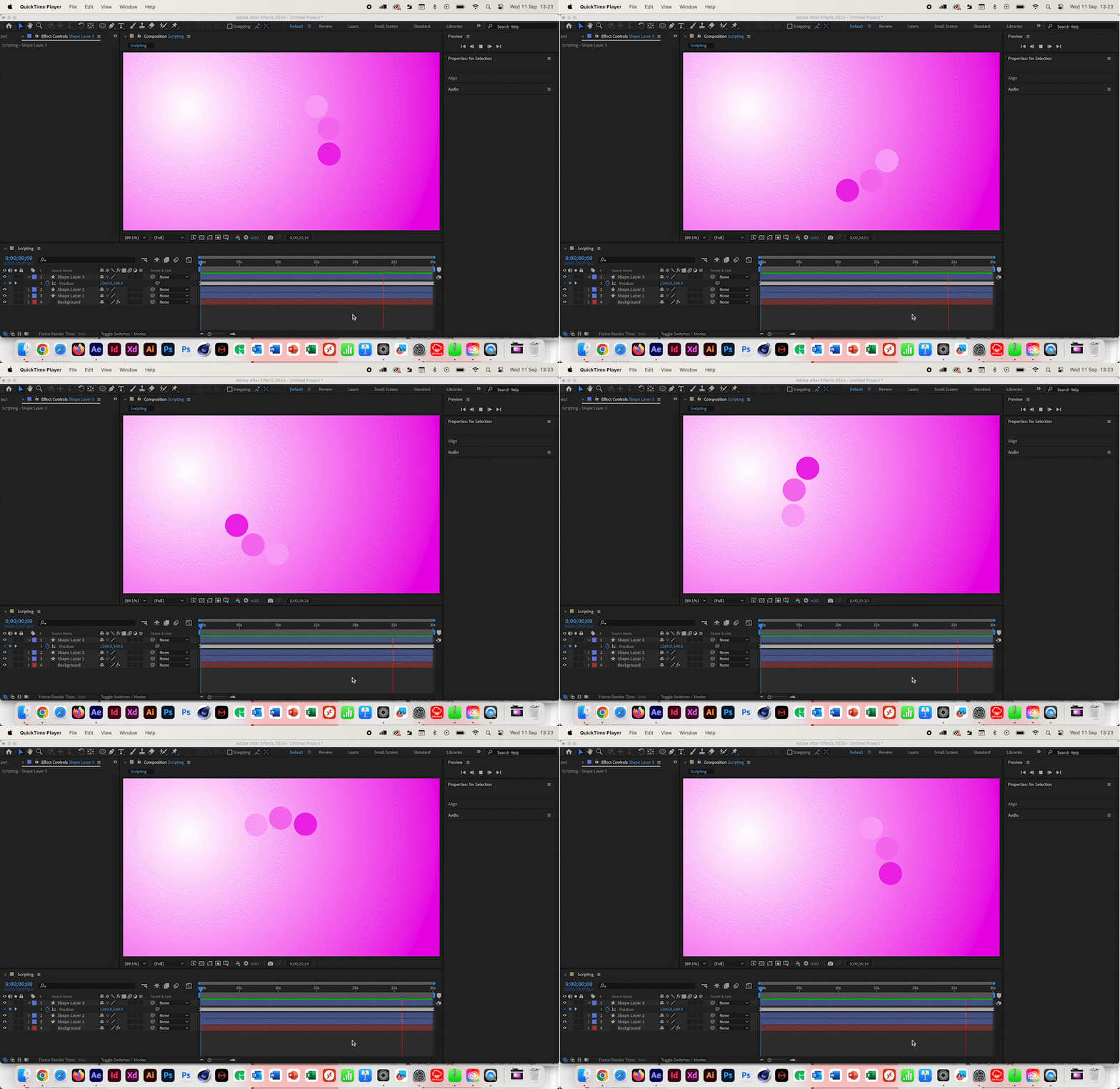
AI scripts in Adobe After Effects were used to enhance teaching and learning by streamlining tasks, boosting productivity, and supporting student literacy. The use of ChatGPT automated complex animations making it easier for students to evaluate the use of AI as a exploration tool within projet ideation phases. By reducing the technical workload, students were able focus more on key learning outcomes.
AI Application: Chat GPT and Adobe After Effects
Impact: Visual exploration (movement), AI Literacy, script vs analog testing, focused learning outcomes and referencing